
When Should You Replace Dry Scrubber Media?
Key Takeaways
- Dry scrubber media removes corrosive, toxic, and odorous gases, but only while it still has active capacity
- Odors and corrosion are late-stage warning signs that media is already spent
- Visual indicators like MBIs and color change provide helpful checks, but only show current condition
- Media Life Analysis testing delivers data-backed insight into remaining media life
- Continuous monitoring enables proactive intervention before gas breakthrough occurs
- The most reliable strategy combines testing and monitoring to avoid reactive failures
Key Signs Your Filtration System Needs Attention
Why Media Maintenance Matters
Think of it this way: You wouldn’t try to drive a car with an empty fuel tank, so why run a filtration system with spent media?
When media reaches exhaustion, gases are no longer treated effectively. Instead of being neutralized, contaminants pass through the system untreated, leading to odor complaints, corrosion, compliance risk, and potential safety issues.
The challenge isn’t understanding that media needs to be replaced, it’s knowing when. While some facilities rely on the “smell test,” there are far more reliable ways to determine whether your media still has usable life remaining.

Common Signs Your Dry Scrubber Media May Be Spent
Odors Breaking Through (The “Smell Test”)
Odors are often the first thing people notice. If downstream odors become detectable, it’s a strong indication that your filtration media should be checked. However, smell is a reactive indicator, not a proactive one.
By the time odors are noticeable:
- Gases are already escaping untreated
- Media capacity has already been exceeded
- The system is no longer performing as designed
This applies across all dry scrubber media types. Odor detection confirms a problem, but it doesn’t help prevent one.
Corrosion or Equipment Damage
Corrosive gases that are no longer being captured by spent media can begin attacking:
- Ductwork and housings
- Electrical enclosures and control panels
- Sensitive electronics and instrumentation
Like odor complaints, corrosion is a late-stage indicator. Waiting until corrosion appears means damage has already begun, often leading to higher repair costs and unplanned downtime. Again, this risk applies regardless of media type.
Visual Indicators Inside the System
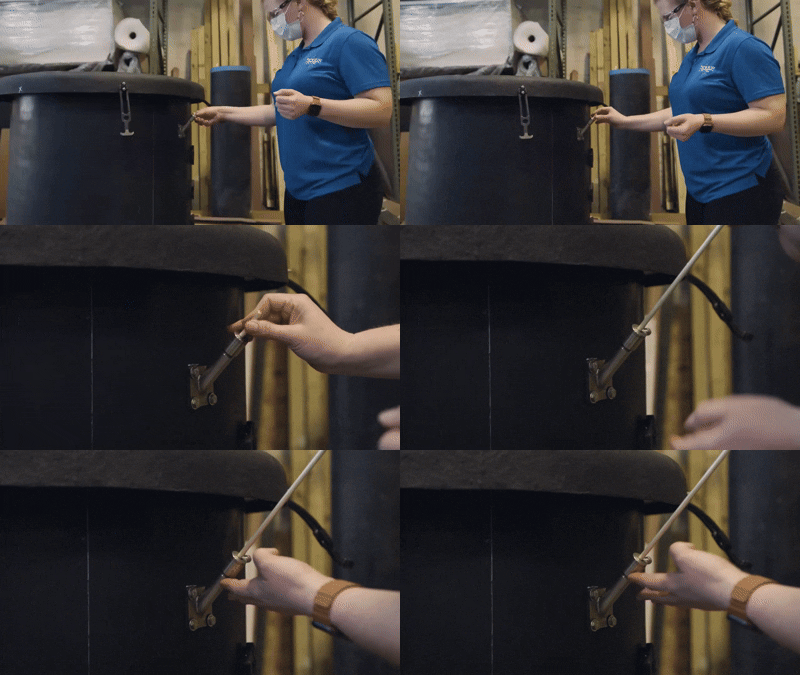
Many deep-bed scrubbers include a Media Bed Indicator (MBI), typically a silver rod inserted into the media bed and periodically removed for inspection.
As the media becomes exhausted, corrosive activity on the rod increases. When corrosion reaches a defined point, it signals that the media bed is nearing the end of its useful life.
Key advantages of MBIs:
- Simple, visual assessment
- No specialized tools required
- Applicable across different media types
If you’re unsure whether your system includes an MBI, or need guidance on how to perform the inspection, support teams can walk you through the process.
Color Change in Potassium Permanganate Media
Purple: Active media
Brown: Spent media
By checking media samples from different access ports, operators can see how far the reaction front has progressed through the bed.
Important note: This visual method only applies to potassium permanganate media. Other adsorbents do not provide a color-change indicator.

Waiting for Symptoms Isn’t Ideal
Odors and corrosion confirm a failure has already occurred. Visual indicators help assess current conditions, but they don’t predict how much life remains.
For facilities that prioritize safety, uptime, and compliance, relying solely on symptoms introduces unnecessary risk. This is where predictive, data-driven testing becomes essential.
Media Life Analysis Testing: The Most Accurate Way to Know Remaining Media Life
Media Life Analysis involves sending media samples to an ISO-accredited laboratory for evaluation. Testing determines how much active capacity remains in the media, not just whether it appears spent.
Why Media Life Analysis Matters
- Provides measurable remaining media life
- Supports proactive maintenance planning
- Helps avoid unnecessary early changeouts
- Prevents unexpected odor events and corrosion
- Shifts maintenance from reactive to predictive
Instead of guessing, facilities gain clarity on whether replacement is truly required — and when it will be.
Advantages of PureAir’s In-House Lab
Media samples can be analyzed through PureAir’s In-House Lab to determine remaining life for existing PureAir media (testing provided at no cost for customers), as well as competitors’ media installed in third-party systems.
Results help teams understand real system performance, optimize replacement schedules, and maintain peak filtration efficiency.
ISO-accredited testing ensures decisions are backed by defensible, auditable data, not assumptions.
Continuous Monitoring: LIFEGARD® Media Bed Monitor
For facilities seeking the highest level of control, continuous monitoring takes predictive maintenance one step further.
LIFEGARD® Media Bed Monitor provides:
- Real-time monitoring of media bed performance
- Early alerts before gas breakthrough occurs
- No routine inspections or physical sampling
- No ongoing maintenance requirements
Operators can check system performance anytime, anywhere, to gain immediate visibility into remaining media life and system health. Continuous monitoring is predictive and proactive, so you don’t have to wait until problems start.
Don’t Run Your System on Empty
Just like a vehicle, a filtration system can’t perform without fuel, and dry scrubber media is what powers contaminant removal.
Facilities generally rely on four approaches to assess media condition:
- Odors or corrosion (reactive)
- Visual indicators like MBIs or color change
- Media Life Analysis testing (predictive)
- Continuous monitoring with LIFEGARD®
Keeping media fresh ensures gases are captured, equipment is protected, and systems perform as designed. The most reliable strategy combines testing and monitoring, so you never have to wait for a problem to tell you your media is spent.
If you have questions about media condition, testing options, or monitoring strategies, contact the PureAir Filtration team to discuss the best approach for your system.