Understanding PureAir Filtration’s Dual ISO Certifications and Why They Matter
Key Takeaways
- PureAir Filtration maintains two ISO credentials: ISO 9001 for company quality systems and ISO/IEC 17025:2017 accredited by A2LA for laboratory competence.
- ISO 9001 ensures consistent manufacturing and operational processes, while ISO/IEC 17025 validates the scientific accuracy of laboratory testing.
- PureAir’s ISO/IEC 17025 accreditation covers testing methods of material types, not just its own products.
- This allows PureAir to perform accredited by A2LA testing on media from multiple manufacturers, providing objective and defensible results.
- Accredited by A2LA testing supports better engineering decisions about media life, corrosion risk, and filtration system performance.
- Few companies in the air filtration industry operate both ISO-certified manufacturing and an ISO-accredited by A2LA laboratory, making this dual capability a meaningful differentiator.
When engineers and plant operators choose filtration media or gas removal systems, they rely on performance claims that affect safety, equipment protection, and system reliability. But how can those claims be verified?
This is where internationally recognized standards are essential.
PureAir Filtration holds two separate ISO credentials that work together to provide confidence in both how products are manufactured and how they are tested. While many companies operate under one of these standards, having both credentials provides an added level of transparency and technical assurance.
To understand why this matters, it helps to break down what ISO standards are and what each certification actually represents.
What Is ISO and Why Does It Matter?
The International Organization for Standardization (ISO) develops globally recognized standards that organizations can follow to demonstrate consistency, reliability, and quality.
When a company is ISO 9001 certified (for management systems) or ISO/IEC 17025 accredited by A2LA (for laboratory competence), an independent auditing or accrediting body has reviewed its systems and/or technical practices and verified that they meet internationally accepted standards.
PureAir Filtration maintains two ISO designations that serve different but complementary purposes:
- ISO 9001 – Covers company operations such as manufacturing, documentation, quality management, and continuous improvement.
- ISO/IEC 17025:2017 – Applies specifically to laboratory testing competence and the scientific validity of test results.
Many companies in the filtration industry maintain ISO 9001 certification. However, ISO/IEC 17025 laboratory accreditation by A2LA is far less common, particularly for in-house laboratories.
That difference is significant because it addresses not just how products are produced, but how performance data is generated and validated. While ISO 9001 plays an important role in manufacturing reliability, it does not evaluate the scientific accuracy of laboratory testing itself. That is where the second certification becomes critical.
ISO/IEC 17025: The Standard for Laboratory Competence
ISO/IEC 17025 focuses on something much more specific: the technical competence of laboratory testing.
Rather than evaluating business systems, this accreditation verifies that laboratory procedures support reliable and technically valid test results.
ISO/IEC 17025 examines:
- Testing methodologies
- Instrument calibration and traceability
- Measurement uncertainty
- Data validation and repeatability
- Technician training and competence
- Quality control of testing processes
Every step involved in performing a test must be independently reviewed and verified. The goal is to ensure that the data generated by the laboratory can be trusted.
For industries that rely on chemical filtration media and corrosion monitoring, this level of verification is crucial.
PureAir’s ISO/IEC 17025 Accreditation Applies to Specific Test Methods Within its Defined Scope, which Includes Multiple Material Types, Not Just its Own Products
This enables PureAir to perform accredited by A2LA testing on media from various manufacturers, providing objective, traceable, and defensible results. These accredited by A2LA test results support informed engineering decisions related to media life, corrosion risk, and filtration system performance.
PureAir’s ISO/IEC 17025 accreditation applies to specific test methods for the following material types:
- Activated carbon pellets
- Alumina oxide beads
- Copper-coated glass coupons
- Silver-coated glass coupons
Because the accreditation applies to the test methods themselves within the laboratory’s defined scope, the laboratory can perform accredited testing on:
- PureAir filtration media
- Media produced by other manufacturers
- Corrosion monitoring coupons from approved sources
This distinction matters.
Some laboratories in the industry maintain accreditation only for testing their own specific product lines, meaning the scope of testing is limited to validating internal products.
PureAir’s accreditation by A2LA is broader. By accrediting the test methods for these material types, the laboratory can evaluate filtration media and corrosion monitoring components regardless of manufacturer.
For engineers and facility operators who need objective performance verification, that flexibility provides an additional layer of technical credibility.
Why These ISO-Accredited Lab Tests Matter in Filtration Applications
Filtration media performance depends heavily on chemistry and physical consistency. Even small variations in composition or structure can affect how effectively a system removes contaminants.
PureAir’s ISO/IEC 17025 accredited by A2LA laboratory performs several tests that directly influence real-world filtration system performance.
Chemical Content Analysis
Testing verifies the presence and concentration of key chemical components such as:
- Permanganate
- Sodium hydroxide
- Sodium thiosulfate
- Phosphoric acid
These active ingredients drive the chemical reactions responsible for removing contaminants like hydrogen sulfide and other gases.
Accurate verification ensures that test results reliably reflect the media’s properties under the conditions tested.
Bulk Density Testing
Bulk density directly impacts:
- Airflow distribution
- Pressure drop across the media bed
- System efficiency
If density varies significantly, airflow patterns can change, potentially reducing filtration effectiveness.
Water Content Verification
Proper moisture levels are critical for predictable chemical reactions in impregnated media.
Too much or too little moisture can affect reaction rates and reduce filtration performance over time.
Carbon Saturation Testing
Carbon saturation testing using temperature rise measurements helps determine adsorption behavior and remaining media life.
This approach provides measurable data rather than relying on visual inspection or estimates when determining replacement intervals.
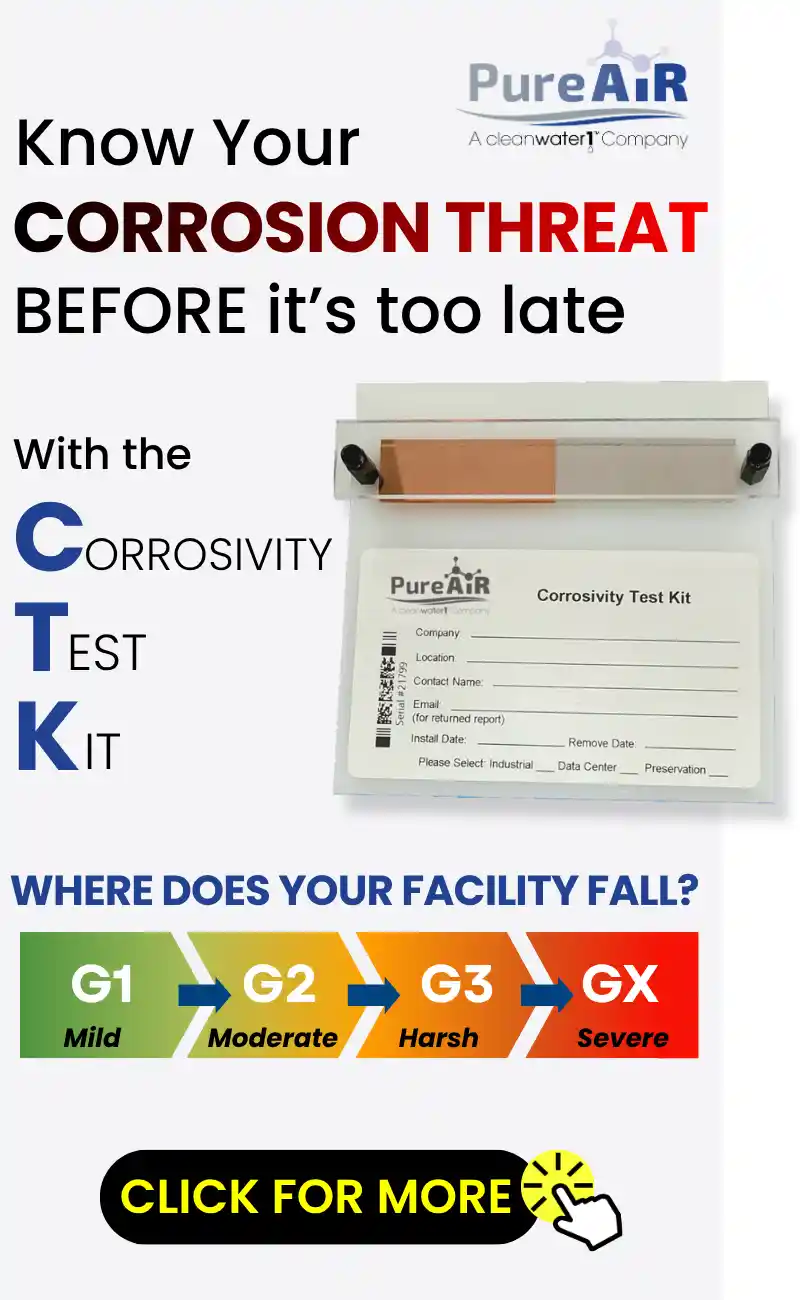
Copper and Silver Corrosion Analysis
Corrosion testing is conducted in alignment with recognized standards including:
- ASTM B825-19
- ANSI/ISA-71.04-2013
These tests measure environmental severity levels that can affect:
- Control systems
- Data center electronics
- Industrial automation equipment
Corrosion monitoring provides valuable insight into air quality risks that could threaten sensitive infrastructure.
Two Layers of Assurance: Manufacturing and Scientific Validation
PureAir’s dual ISO credentials provide two complementary levels of quality assurance:
- ISO 9001 confirms that manufacturing processes are controlled and consistent.
- ISO/IEC 17025 accredited by A2LA confirms that laboratory supports reliable and technically valid test results.
Together, these certifications ensure that both product production and performance verification meet internationally recognized standards.
In an industry where filtration performance can affect safety, equipment protection, and operational uptime, having both layers of verification provides valuable confidence.
A Broader Scope of Testing Capability
Another advantage of PureAir’s laboratory accreditation is its expansive testing scope.
Because the accreditation applies to testing procedures and material types, the laboratory can evaluate:
- PureAir filtration media
- Media from other manufacturers
- Corrosion monitoring coupons from various suppliers
This allows engineers, consultants, and facility operators to obtain objective testing data, even when the materials being evaluated were not produced by PureAir.
For facilities evaluating filtration media options or analyzing corrosion conditions, access to an independent, accredited by A2LA testing methods can support more informed decisions.
Supporting Safer and More Reliable Air Filtration Systems
In industrial environments where gases like hydrogen sulfide, chlorine, or other corrosive contaminants are present, filtration performance must be predictable and verifiable.
Reliable testing data supports decisions about:
- Media selection
- Replacement intervals
- System design adjustments
- Corrosion mitigation strategies
- Long-term operating costs
By combining ISO-certified manufacturing with ISO/IEC 17025 accredited by A2LA laboratory testing, PureAir Filtration provides a foundation of reliability that extends from product production to performance verification.
Contact PureAir Filtration for Proven Gas Filtration Expertise
When gas removal performance, corrosion protection, and system reliability matter, working with a partner that combines engineered filtration solutions with accredited by A2LA laboratory testing can make a meaningful difference.
PureAir Filtration supports facilities across industries with proven solutions for odor control, toxic gas removal, and corrosion protection, backed by validated testing and engineering expertise.
If you would like to learn more about PureAir’s filtration systems, laboratory capabilities, or testing services, contact the PureAir Filtration team to discuss your application.