Is Your Facility G1? Understanding ISA Corrosion Classifications
الوجبات السريعة الرئيسية
- ISA 71.04 classifies environments as G1, G2, G3, or GX based on their potential to cause corrosion to electronic and electrical equipment.
- G1 represents a mild environment where corrosion is not considered a significant factor in equipment reliability.
- Copper and silver reactivity measurements can provide an objective indication of the corrosivity of a facility environment.
- Corrosion risk is influenced by more than contaminant concentration. Humidity, temperature, and the combined environmental conditions also matter.
- Corrosivity testing can establish a baseline and help determine whether additional gas-phase filtration is necessary.
- Continuous filtration and environmental monitoring can help facilities maintain conditions that protect sensitive electronics.
Corrosive gases can be present in industrial environments long before they create an obvious problem. Hydrogen sulfide, sulfur dioxide, chlorine, ammonia, and other airborne contaminants can gradually attack circuit boards, instrumentation, control systems, and other sensitive electronic equipment. The challenge for facility managers and engineers is determining whether the environment is adequately controlled or whether corrosion is already putting critical equipment at risk.
ISA corrosion classifications provide an objective way to answer that question. Under ISA 71.04, environments are classified from G1 to GX based on their potential to cause corrosion. For facilities that depend on sensitive electronics, achieving and maintaining G1 conditions can be an important part of protecting reliability and uptime.
What Does a G1 Corrosion Classification Mean?
G1 is the target classification for a well-controlled environment. Under ISA 71.04, G1 is considered a mild environment in which corrosion is not a significant factor in determining equipment reliability. As corrosion severity increases, an environment may be classified as G2, G3, or GX.
In practical terms, the classifications indicate increasing levels of environmental risk:

View Full ISA Classification Chart
What Causes an Environment to Move Beyond G1?
Corrosion severity is influenced by the total environment surrounding electronic equipment. Common airborne contaminants that can contribute to corrosion include:
- كبريتيد الهيدروجين (H₂S)
- ثاني أكسيد الكبريت (SO2)
- الكلور (Cl₂)
- أكاسيد النيتروجين (NOₓ)
- الأمونيا (NH₃)
- الأوزون (O₃)
- فلوريد الهيدروجين (HF)
Contaminant concentration is important, but it is not the only variable. Temperature, humidity, exposure time, and the interaction of multiple contaminants can influence how aggressively an environment attacks metals.
This is why simply measuring the concentration of one gas does not necessarily provide a complete picture of corrosion risk. A facility needs to understand the actual corrosive effect of the environment on the materials found in electronic equipment.
Why Maintaining G1 Conditions Matters
Maintaining a G1 environment is about more than satisfying an industry standard. It can directly affect equipment reliability, maintenance costs, facility uptime, and even warranty coverage for critical electronic systems.
Corrosion of electronic components often develops gradually. A control room may appear clean and properly maintained while airborne contaminants are slowly reacting with circuit boards, connectors, contacts, and instrumentation. Eventually, this deterioration can contribute to intermittent faults, equipment failures, repairs, or premature replacement.
The financial impact can extend beyond the damaged component itself. A failed control system can interrupt production or critical facility processes, while replacement electronics and emergency maintenance add unexpected costs. Many equipment manufacturers also require electronics to operate in a G1 environment; if a failure occurs in a more corrosive setting, warranty coverage may be denied because environmental conditions contributed to the damage.
Maintaining G1 conditions helps minimize these risks by controlling corrosive contaminants.
Is Your Facility Really G1?
Visual inspection alone cannot determine whether a room meets G1 conditions. Establishing the actual corrosion classification requires testing.
Testing is particularly valuable when:
- Sensitive electronics are installed near processes that generate corrosive gases.
- Electronic components are failing prematurely without an obvious cause.
- A new control room or protected space is being commissioned.
- Facility personnel need documentation of environmental conditions.
- Operating conditions or contaminant loads have changed.
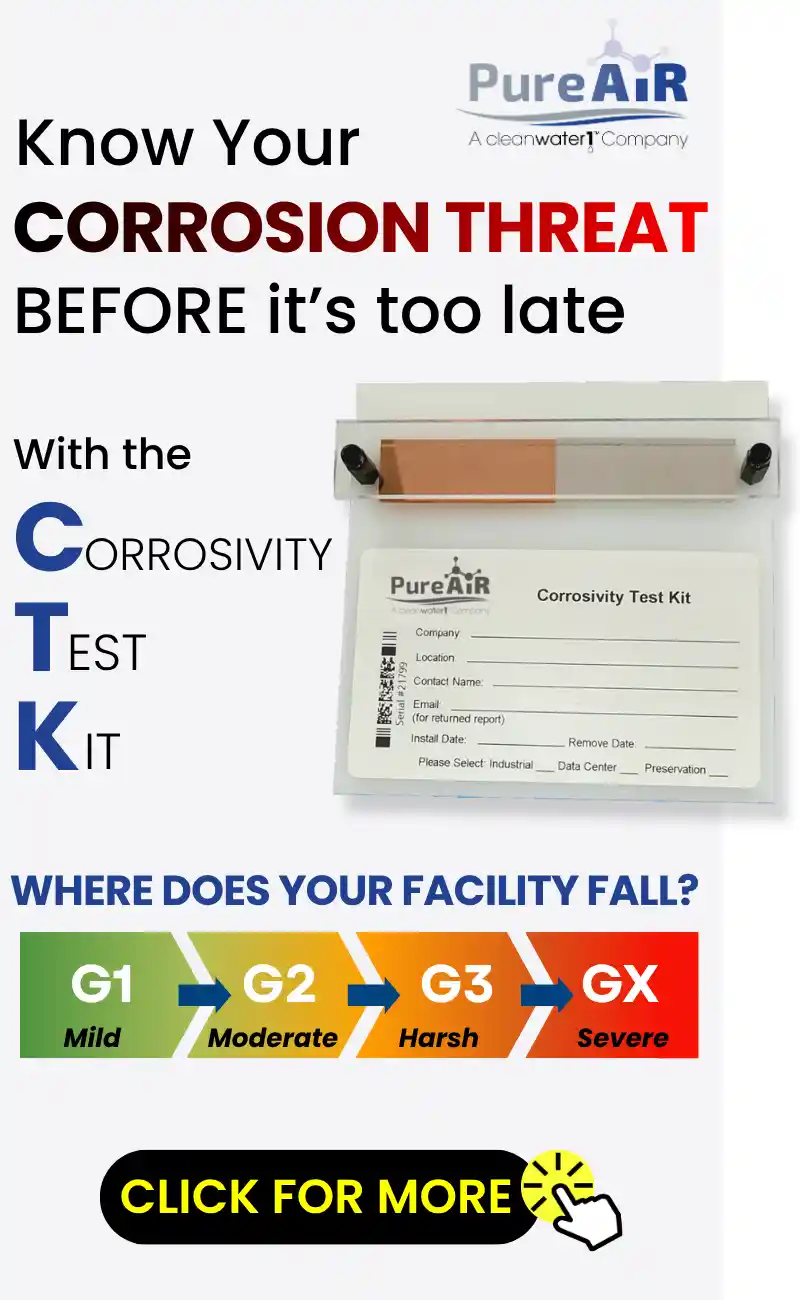
Corrosivity testing provides an objective way to establish a baseline for the environment and verify whether conditions are suitable for reliable operation of sensitive electronics. One of the most common methods for evaluating environmental corrosivity is PureAir’s Corrosivity Test Kit (CTK), which provides a straightforward way to assess an environment.

Copper and silver strips are placed in the area being evaluated for 30 days. After exposure, the strips are returned to our in-house laboratory for analysis.
Results provide copper and silver ISA ratings and identify the corrosive gases present. This gives facility personnel a clearer understanding of the room’s air quality and can help determine whether additional measures are necessary to protect critical electronics.
Testing is useful not only when corrosion is suspected. Periodic testing can also help verify that an environment intended to remain G1 is continuing to perform as expected.
How to Maintain a G1 Environment
If testing indicates that an environment is more corrosive than desired, the next step is identifying the sources of contamination and developing an appropriate control strategy.
There is no single solution for every facility. The correct approach depends on factors such as contaminant type and concentration, airflow, room conditions, equipment sensitivity, and the facility’s operational requirements.
PureAir can help evaluate these factors and develop an approach based on the facility’s specific conditions.
Packaged Filter Units for Corrosion Control
Packaged Filter Units (PFUs) provide continuous air purification in spaces where controlling corrosive gases is critical.
When configured with the appropriate Chemisorbant media, these systems remove harmful gaseous contaminants from the air before they can reach sensitive electronic equipment.
The media selection should be matched to the facility’s contaminant profile so that the filtration system addresses the gases actually present rather than relying on a one-size-fits-all approach.
Continuous Corrosion Monitoring with ECMv2

Periodic testing provides a snapshot of environmental corrosivity. For facilities where conditions can change, continuous monitoring can provide additional visibility.
PureAir’s جهاز مراقبة التآكل البيئي (ECMv2) monitors room conditions and provides live copper and silver ISA ratings along with temperature, humidity, and differential room pressure.
This information allows facility personnel to track conditions over time and identify developing corrosion concerns before they result in equipment damage.
Know Your ISA Corrosion Classification Before Equipment Is at Risk
Corrosion problems are much easier to manage when they are identified before critical electronics begin to fail. Whether you need to establish your facility’s baseline ISA classification, investigate unexplained electronic failures, verify the performance of an existing filtration system, or continuously maintain a G1 environment, the first step is understanding the conditions surrounding your equipment.
Contact the PureAir Filtration team to discuss corrosion testing, environmental monitoring, and gas-phase filtration solutions designed to help protect sensitive electronics and maintain the conditions your facility requires.
| تصنيف ISA | ||||
|---|---|---|---|---|
| G1 | G2 | G3 | GX | |
| خفيف (مقبول) | معتدل | قاس | حاد | |
| التآكل ليس عاملاً | التآكل قابل للقياس | احتمالية عالية لحدوث هجمات التآكل | لا يُتوقع أن تبقى المعدات الإلكترونية/الكهربائية صالحة | |
| مستوى تفاعل النحاس | 0-299 أنجستروم | 300-999 أنجستروم | 1000-1999 أنجستروم | ≥ 2000 أنجستروم |
| مستوى تفاعل الفضة | 0-199 أنجستروم | 200-999 أنجستروم | 1000-1999 أنجستروم | ≥ 2000 أنجستروم |
| الملوثات | التّركيز | |||
| H2كبريتيد الهيدروجين S | <3 جزء في البليون | <10 جزء في البليون | <50 جزء في البليون | ≥ 50 جزء في المليار |
| SO2 ثاني أكسيد الكبريت | <10 جزء في البليون | <100 جزء في البليون | <300 جزء في البليون | ≥ 300 جزء في المليار |
| CL2 الكلور | <1 جزء في البليون | <2 جزء في البليون | <10 جزء في البليون | ≥ 10 جزء في المليار |
| لاx أكاسيد النيتروجين | <50 جزء في البليون | <125 جزء في البليون | <1250 جزء في البليون | ≥ 1250 جزء في المليار |
| NH3 الأمونيا | <500 جزء في البليون | <10,000 جزء في البليون | <25,000 جزء في البليون | ≥ 25,000 جزء في المليار |
| O3 الأوزون | <2 جزء في البليون | <25 جزء في البليون | <100 جزء في البليون | ≥ 100 جزء في المليار |
| فلوريد الهيدروجين HF | <1 جزء في البليون | <2 جزء في البليون | <10 جزء في البليون | > 10 جزء في المليار |
| تصنيف ISA لـ GLAM | |||||
|---|---|---|---|---|---|
| CS/S1 | سي 2/س 2 | سي 3/س 3 | سي 4/س 4 | سي 5/س 5 | |
| الأرشيفات، المعادن، المجموعات، الكتب النادرة | المتاحف، المتحف، التخزين، المكتبات | البيوت التاريخية | مقبول على المدى القصير | غير مقبول | |
| مستوى تفاعل النحاس | مستوى تفاعل الفضة | ||||
| الفئة | تصنيف جودة الهواء | معدل التآكل لكل 30 يومًا | الفئة | تصنيف جودة الهواء | معدل التآكل لكل 30 يومًا |
| C1 | نقي للغاية | < 90 أنجستروم | S1 | نقي للغاية | < 40 أنجستروم |
| C2 | نقي | < 150 أنجستروم | S2 | نقي | < 100 أنجستروم |
| C3 | نظيف | < 250 أنجستروم | S3 | نظيف | < 200 أنجستروم |
| C4 | ملوث قليلا | < 350 أنجستروم | S4 | ملوث قليلا | < 300 أنجستروم |
| C5 | ملوث | ≥ 350 أنجستروم | S5 | ملوث | ≥ 300 أنجستروم |